
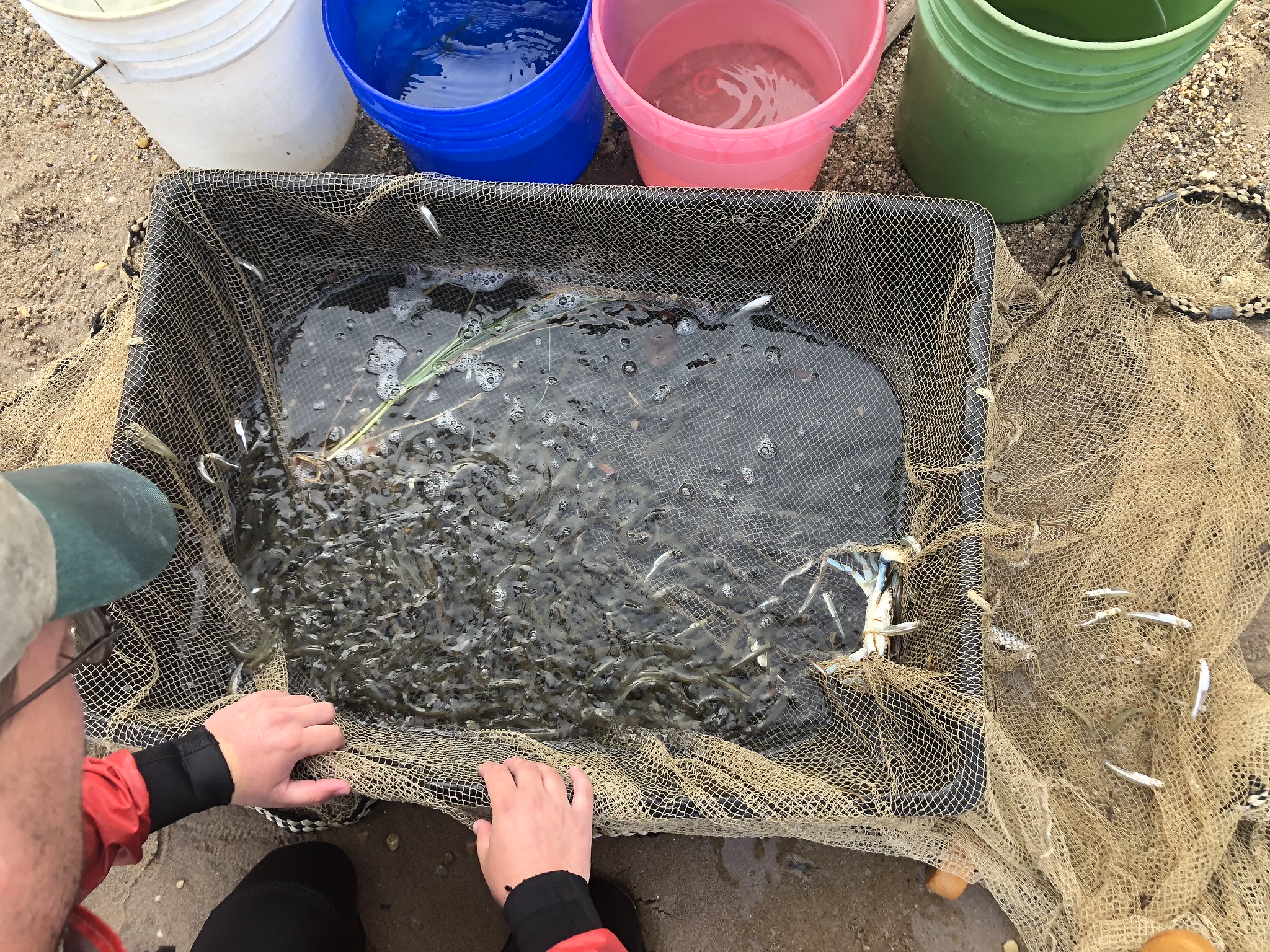
A seine net yields numerous species for scientists to study. Maryland DNR photo.
The green-brown waters of the Chesapeake Bay can appear mysterious, but the Maryland Department of Natural Resources regularly conducts surveys to reveal life below the surface.
During Maryland Science Week in fall 2025, the Maryland Department of Natural Resources (DNR) gathered with Huntingtown High School’s AP environmental science class and staff from Smithsonian Environmental Research Center at Reed Education Center to demonstrate one way biologists gather data on the life in the Bay’s brackish waters—seine net surveys.
Students participated in a hands-on demonstration of this survey method and a discussion of how land use, particularly the construction of impervious surfaces such as roads and parking lots, impacts fish habitat. Biologists explained that areas with 10% or more impervious surface can negatively impact fish habitat by reducing water clarity and dissolved oxygen.
As the group watched from the center’s beach, the crew deployed and retrieved a 100-foot-long, 4-foot-deep beach seine net from the Rhode River. They first waded out into the water to spread the net over a wide swath, then the crew gradually came closer together with the net, bringing the aquatic life within that area into a smaller and smaller space, until the scientists brought the entire net together and placed it in a container of water on the shore.
The net revealed a variety of local species, including striped bass, blue crab, menhaden, silversides, and even a horseshoe crab.
These types of surveys have long been beneficial to fisheries biologists as a way to study fish in near-shore environments. The department uses seine net surveys for various annual and periodic research efforts. With different mesh sizes and study areas, these surveys can be developed to capture different types of fish for closer inspection or contribute to valuable data collection.
Several of DNR’s seine studies are funded by the Sport Fish Restoration Fund. Fishing license, tackle, boat, and marine fuel purchases fund DNR’s fish conservation work. Fishing licenses can be purchased online through MD Outdoors or in person at license agent locations.
Estuarine Fish Community Sampling Study
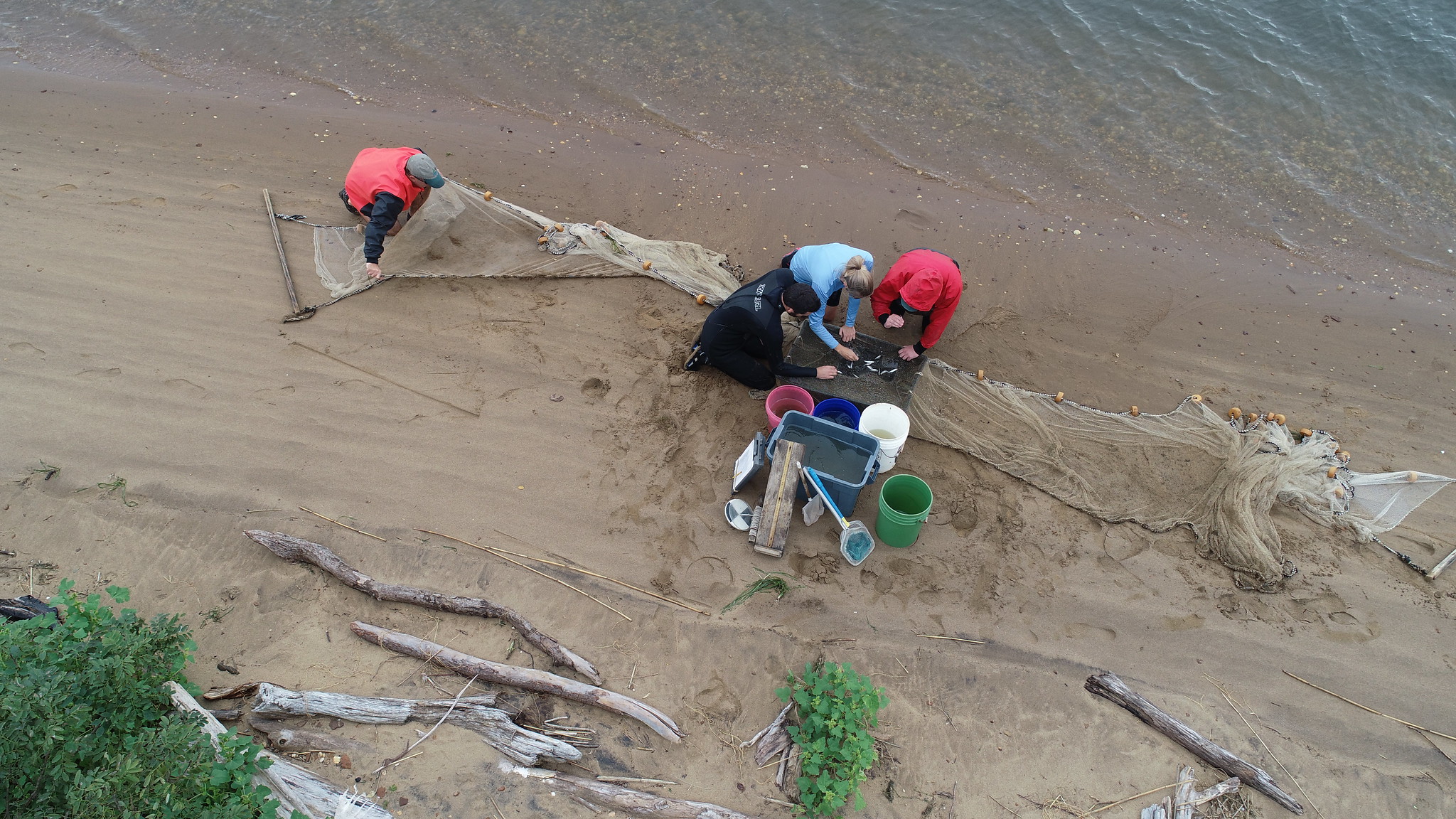
DNR’s annual young-of-year survey uses seine nets to estimate juvenile fish counts. Maryland DNR photo
Each summer, DNR biologists in the Fisheries Ecosystem Assessment Division pull beach seine nets 130 times at different locations in the shallow waters of Chesapeake Bay tributaries. Fish caught are separated by life stage, counted, and select species are measured. Water quality readings are also taken.
Biologists use these data to evaluate the nursery and adult habitat of recreationally important finfish. Species examined in the survey include striped bass, yellow perch, white perch, alewife, blueback herring, American shad, hickory shad, spot, Atlantic menhaden, bay anchovy, spottail shiner, silvery minnow, and gizzard shad. In 2025, the survey’s beach seines caught 50 species. These included freshwater species such as largemouth bass, chain pickerel, and black crappie, and marine species like bluefish, black drum, and northern puffer.
Juvenile Striped Bass Survey
Striped bass, locally called rockfish, are Maryland’s state fish. They are recreationally and commercially important from Maine to North Carolina, and the Chesapeake Bay is the primary spawning ground for the East Coast population.
Conducted annually by DNR since 1954, the Maryland Juvenile Striped Bass Survey is one of the longest-running continuous fish surveys in the United States. Since its inception, more than 100 fish species have been collected in this survey. The survey assesses the success of striped bass reproduction in the previous year. The relative abundance of the other fish observed in the seine nets each summer is also documented. Recording the number of young-of-year fish over time helps biologists predict how many adult fish will be present in future years as those fish grow.
DNR biologists deploy and pull in seine nets at 22 locations throughout Maryland’s portion of the Chesapeake Bay, repeating the process at every site to increase the accuracy of the samples. These sites and methods remain consistent each year, allowing biologists to create an annual index comparing the number of young fish present over time.
Recent survey results have been concerning. Scientists have observed consistently low numbers of striped bass less than one year old compared to the survey average of the past seven years. Although the breeding-aged adult stock of striped bass is currently strong, the insights gained by counting hundreds of two-inch-long juvenile striped bass each summer provide early warning that the population could decline in the coming years.
Shad Restoration
Maryland DNR has worked to restore American and hickory shad in the Chesapeake Bay since the late 1990s. To measure the success of these efforts, biologists conduct haul seine surveys annually from late summer to early fall. The seine nets in this survey are deployed by boat due to deep water and sometimes inaccessible shoreline along the Choptank River and Patapsco River, where the sampling occurs.
At ten locations, one side of a 200-foot net is brought to shore by a biologist in the water, while the other side is pulled in a circle by another team member in a small boat. A team of biologists pulls the remaining net in by hand until the fish are trapped in a pocket in the net. Biologists count fish by species and collect a subsample of shad for further analysis in a laboratory setting. Data from the survey are used to calculate wild abundance estimates, larval mortality rates, and assess stocking success.
DNR’s stocking efforts have led to the restoration of hickory shad in both the Patuxent and Choptank rivers. However, survey results show that a lack of spawning adults remains a significant barrier to population growth in other systems.
Coastal Bays Seine Surveys
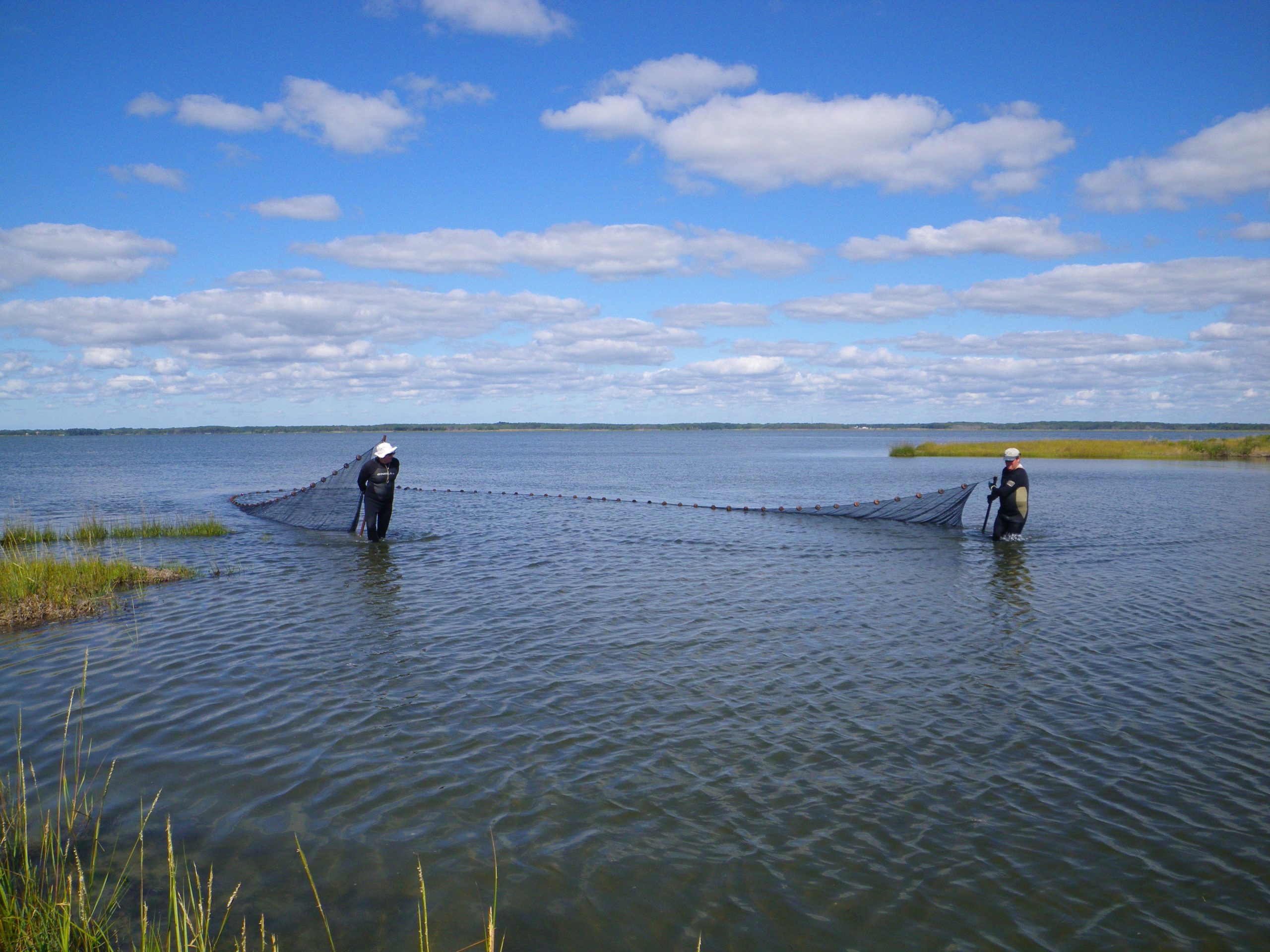
Maryland DNR photo
On the ocean side of Maryland’s Eastern Shore, Assawoman, Isle of Wight, Sinepuxent, Newport, and Chincoteague Bays are tucked behind Assateague Island and Ocean City. Water from about 175 square miles of Maryland’s coastal plain drains into these bays. Beneath the water, these habitats serve as nurseries for species such as summer flounder, black sea bass, weakfish, spot, croaker, menhaden, American eels, and bluefish.
Each June and September, the Coastal Fisheries Program conducts 38 pulls using a 100-foot-long, 6-foot-deep bag seine with 0.25-inch mesh, a buoyed float line, and a weighted footrope in the coastal bays. Biologists identify and measure the first 20 encounters with all fish species and blue crabs.
Vegetation and invertebrates, including jellyfishes are also accounted for. Submerged Aquatic Vegetation is an essential habitat that the young of many fishes depend upon for protection and feeding. The department began sampling SAV beds in 2012 with standardization in 2015. These surveys collect water temperature and water pH measurements for a set of data points about the status of Maryland’s Coastal Bays.
The data collected from this survey are used in the calculations for many different outputs, including stock assessments, federal reporting, and university studies. These data provide a snapshot of fish communities and abundance in Maryland’s coastal bays, informing management strategies that protect these unique environments where finfish live and spawn. For example, the abundance of tautog resulted in the department working to have the juvenile index incorporated into the next Atlantic States Marine Fisheries Commission benchmark stock assessment.
Since the survey began in 1972, more than 130 adult and juvenile fish species, 26 mollusks, and 11 macroalgae have been documented. The most recent published survey results indicated that the stability of coastal bay fisheries varies by species. Typically, finfish were the most abundant taxa captured in the seine survey and the accompanying trawl portion of this investigation.
